
An assistant that can only talk
You paste notes into ChatGPT or Claude. It can suggest a flight. It cannot check availability or book one.
We build Model Context Protocol servers and AI plugins so agents and LLMs can understand and interact with your product autonomously.
Copy-pasting into a chat window does not scale. Customers and staff already ask assistants to do real work. Without a safe link to your product, those assistants guess or send people elsewhere.
An MCP server, or the right vendor plugin, gives the assistant a permissioned way to call your product. We design the tools, harden the boundaries, and ship something you own.
MCP is an open standard for connecting AI assistants and agents to tools and data.
Think of it as USB for AI: one protocol, many connectors.
An AI assistant replies to questions. An AI agent can also take actions: look things up, write to your systems, or finish a task such as booking a flight.
MCP is the shared connection layer. Assistants can pull live information. Agents can run allowed actions, within the permissions you set.
You paste notes into ChatGPT or Claude. It can suggest a flight. It cannot check availability or book one.
Through MCP, the agent calls your tools, reads live data, and completes the allowed action under your permission rules.
Short definitions used on this page. See also our glossary.
Anyone can now get a complete set of product requirements for their app, fully costed, without leaving ChatGPT.
ChatStack is our multi-agent workflow. It turns a client conversation into a structured product requirements document (PRD) and a fixed-price estimate. It cut our own lead-to-conversion time from about two months to about three weeks.
Today, we've created a ChatStack MCP surface for AI agents. You connect an MCP-aware assistant (like Claude, Cursor or Windsurf), and it can communicate with ChatStack behind the scenes to run the interview and return a PRD and cost.
To see ChatStack in action visit www.chatstack.app.
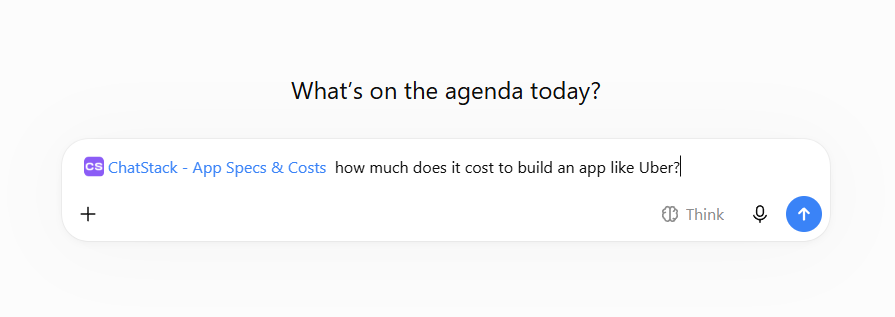
A user or agent asks a question. ChatGPT recognises your platform can answer it.
Ready when you are.
@chatstack how much does it cost to build an app like Uber?
An Uber-like platform costs more than a normal app because you are really building several products at once.
| Version | Typical cost |
|---|---|
| Prototype | $20k–$50k |
| MVP | $80k–$150k |
Responses appear in ChatGPT.
ChatStack Plugin + MCP
The bridge that carries the question to your product and brings the answer back.
Your platform generates the response
Live tools, data, and business rules run on your side, within the permissions you set.
AI agents and LLMs can understand and interact with your product autonomously, within boundaries you control.
Expose capabilities as tools and an agent can read and write through the same boundaries your own clients use. That is operating the product, not only answering questions about it.
People already live in ChatGPT, Claude, and coding agents. A connector lets them use your product without leaving the assistant they trust.
MCP is a shared protocol. Design the tools once, then connect the assistants that matter. Vendor plugins still make sense when one platform owns the audience.
We build an MCP server first, then wrap it for the assistants people already use. This sits under our AI Solutions for Clients pillar.
Put your product inside ChatGPT so users can run workflows without leaving the chat.
Best when your audience already works in ChatGPT.
Skills and tools that let Claude call your product with clear permissions and structured outputs.
Best when Claude is where your team or customers already work.
Plugins and MCP wiring for coding agents such as Cursor and Claude Code, so developers pull live product context while they build.
Best when the primary users are engineers inside an IDE.
A laptop demo is not a connector you put in front of customers. These are the table stakes.
Named actions and readable resources that map to real product capabilities.
Callers prove who they are. The server only exposes what each one may use.
Server-side rules for what may be read or changed. The assistant is not a back door.
Stops a chatty agent or misconfigured client from overwhelming your backend.
Clear, machine-readable failures so agents can recover instead of looping blindly.
See which tools ran, by whom, and what failed, without logging secrets you should not keep.
Every tool, required auth, and example calls, so others can connect without asking us first.
A deployable service you can evolve without silently breaking every connected assistant.
We exercise the server with the assistants you care about, not only unit tests.
Which actions matter, which data is safe to expose, and which assistants your users live in.
Names, inputs, outputs, and permissions written down before code.
MCP server, ChatGPT App, Claude Skill, or IDE plugin, wired to your existing APIs.
Auth, scopes, rate limits, structured errors, logging, then a pass with real assistants.
You own the code, docs, and deployment path. We stay on for iteration if you want a retainer.
MCP is an open standard for connecting AI assistants and agents to tools and data. Think of it as USB for AI: one protocol, many connectors. An assistant can pull live information. An agent can complete actions, such as booking a flight, within the permissions you set.
An AI assistant replies to questions. An AI agent can also take actions. With permission it can look things up, write to your systems, and finish a task rather than only describe how you might do it.
A small service between an AI assistant or agent and your systems. It advertises tools they may use and enforces authentication and permissions when those tools are called.
An API is built for applications and developers. An MCP server is built for AI agents. It describes tools in a form assistants understand and returns structured results agents can act on. Most MCP servers wrap an existing API rather than replacing it.
So AI agents and LLMs can understand and interact with your product autonomously: staff copilots, distribution inside assistants customers already use, and coding agents that pull live product context.
Yes. MCP servers are the open-standard core. We also build ChatGPT Apps and Actions, Claude Skills, and Cursor or other IDE plugins when that is where your users already work.
It depends on the tools, auth, and assistants you need. We scope against your product, estimate the hours, and quote a fixed price before work starts.
A focused first connector with a handful of tools often lands in weeks. Broader surfaces or multiple vendor plugins take longer. We say which shape you have during scoping.
It can be, when the server enforces authentication, consented scopes, and permission boundaries, with rate limiting and logging. The assistant gets only the access you grant.
Yes. Many strong MCP servers stay on the company network. Knowledge bases, ticketing, CRM, and ops tools are common targets for staff copilots.
It can. Assistants that support tools can surface your product when a user asks for work your connector can do. Clear tool names and docs are part of that build.
Tell us what your product does and which assistants your users live in. We will scope an MCP server or AI plugin and quote a fixed price before work starts.
Anthropic and OpenAI and Cursor are registered trademarks of their respective owners. App Developer Studio is not affiliated with, endorsed by, or sponsored by Anthropic and OpenAI and Cursor. MCP (Model Context Protocol) is an open standard. We implement MCP servers and AI plugins for client products. We do not resell, license, or redistribute Anthropic, OpenAI, or Cursor software, and we are not affiliated with those companies unless stated elsewhere.